

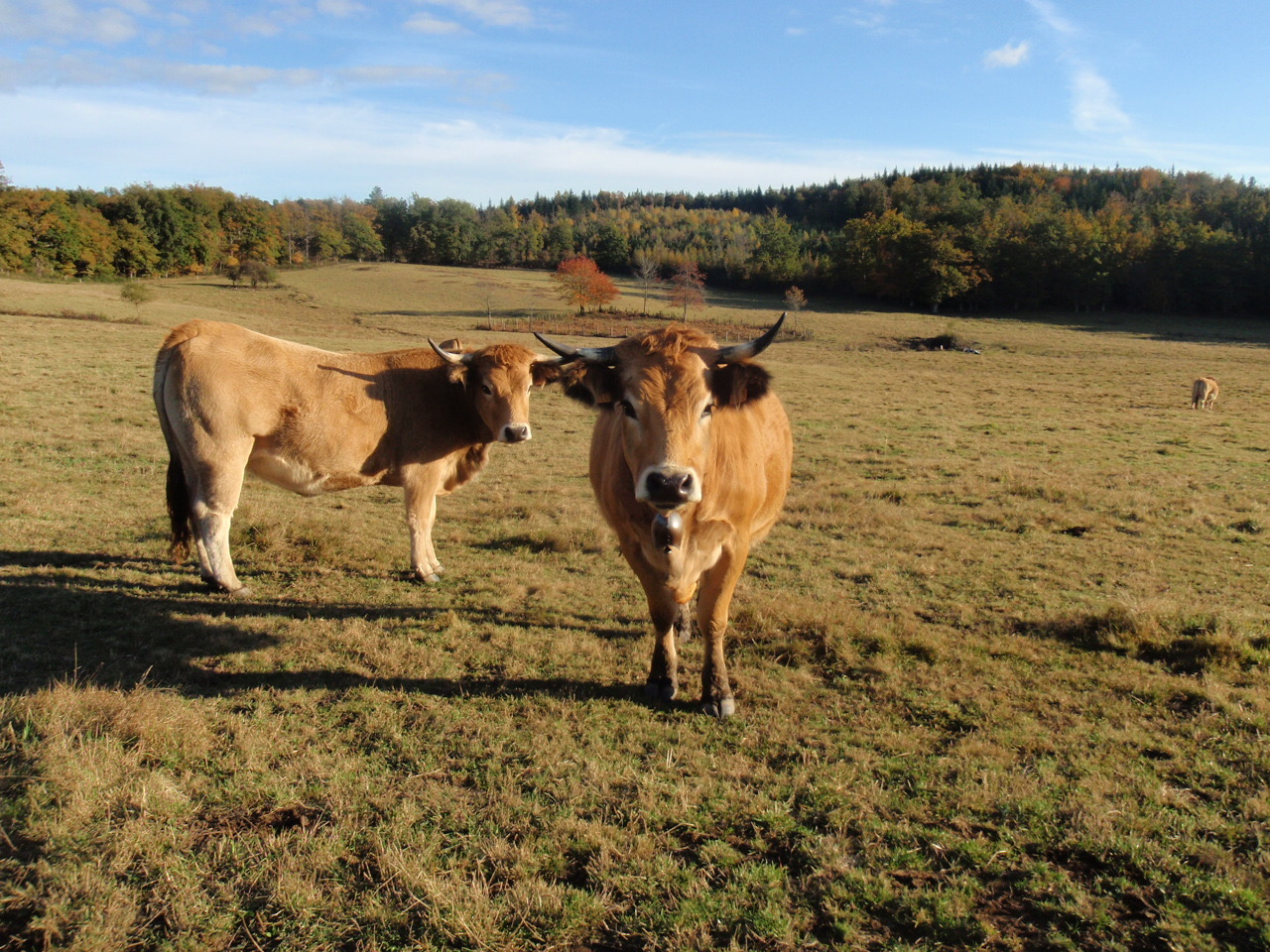
This weekend, it’s THE TRANSHUMANCE — and all of a sudden, out of the quiet of our countryside, we are going to welcome thousands of tourists who will come to “watch the cows go by.” Already since the beginning of the week, the crowds have been building. It has become “the event not to be missed” — the great gathering (nobody quite knows why) of motorhomes, which line up all along the roads to watch the cows pass. Well… on the farms, the preparations are of a rather different kind.
Yesterday, I drove up to fish on the Aubrac, and all these memories came rushing back to me at once. So I said to myself — I’m going to tell you about them!
As they say, “We take the cows up to the summer pastures” or “They’re heading to THE Mountain.” Here in the Aveyron, the transhumance allows the herds to be “up there,” where the grass is in bloom and the pastures are rich, while down in the valley — or “back at the farm” — the farmers will be haymaking, stacking bales for the winter ahead, which will be a harsh one.
But not just any cows — Aubracs! For the simple and good reason that they are hardy and can live up there without too much watching over; they are robust and rustic, they calve without needing a helping human hand. They are one of the breeds closest to the Aurochs — the very animal found in the cave paintings of prehistoric grottos!
So we are going to tell you about the Transhumance, as it is called today. In any case, I am going to tell you about the one I know, and you will be able to watch this film shot at Monsieur Causse’s farm, from Gages le Haut, at the summer pastures of Canuc, beyond Aubrac (the village).

I remember the transhumances of my teenage years, with Mr. Boubal — we would set off from Zenières in Montrozier all the way to Aubrac. Already the evening before, and even two days before, the excitement was building: the bells had to be brought out, decorated, and everyone pitched in. The cows were mooing in their stalls — they knew something was happening. The young ones were intrigued, while the others knew that the time had come for “the mountain”!
In the morning, around 4 o’clock, we would dress the cows, fitting them with their bells — a whole ceremony in itself. The calves were separated from their mothers, the heifers set aside, as were the bulls. The mooing grew louder and louder — the mothers calling for their calves and the calves for their mothers. The bulls, for their part, were perfectly calm. They seemed to know that, like the calves and the heifers, they would make the journey by cattle truck. In those days, it was a Berliet Stradair — pastis green — and a fine-looking machine it was! There would be several trips back and forth.

Our eyes were stinging with tiredness, but we were proud to be among “the grown-ups,” to have a responsibility, however small it might be. And the 43 kilometers that stood between us and the Mountain held no fear for us whatsoever!
At first, the job is simple: you move ahead of the herd and are posted at crossroads to stop the animals from turning down the wrong path — or from doubling back to find their calves! Or simply to hold up the traffic. Once the herd has passed, you fall in behind to push them along, with great shouts of “Hé Béééé!” Or you move up front, calling out to them — “Vaysse y bé! Vaysse y bé!” — the dogs lending a hand, while daybreak rises over the causse.
The first village is Gabriac — the streets must be blocked off, the cars brought to a halt, and the herd begins to string out. The young ones, lively and cheerful, trot along at a brisk pace, blissfully unaware of the road that lies ahead. No doubt they are thinking, “Oh great, we’re changing pastures!” The older ones know the drill and walk on peacefully. We begin the descent toward the valley, and in the distance, the Aubrac comes into view… the road is long. The descent begins, and a few tourists at the Roquelaure lava flow stop to take photographs. It’s easy going — it’s all downhill!
We cross the Lot at Saint-Côme — all the cows head to the watering trough while we make for the bistro to pick ourselves up and gather some strength. A well-earned breakfast, but not coffee and toast, mind you! A proper one — dry sausage, pâté, cheese, a coffee — and off we go again. But now it’s a different story altogether: we have to climb!
We play traffic cop, holding up the cars while the herd strings out along the road — a hundred cows heading uphill makes for quite a procession! And then there we are, in the shade beneath the beeches and chestnut trees. The herd begins to split up: those with a steady rhythm, those who lag behind and need a shove, and those who stick together in their own little groups. The 4L (the farmer’s car) drives us up ahead and we check that all the “clèdes” — the field gates — are shut tight, to stop the cows from wandering in.
We finally reach Salgues, now on the edge of the plateau. The climb has been a tough one, and the cows make straight for the trough to quench their thirst — they’ve been grazing all the way up. And as for us, well, in Salgues, we sit down to lunch! Our feet are heavy, our calves are burning, but we put on a brave face because we want to act like “the grown-ups,” all of thirteen years old.
The herd now stretches out over more than a kilometer, each small group moving at its own pace, with one man up front and one behind to guide it. In the distance, the woods of Aubrac come into view, and beyond them, the final climb. The sun is beating down — it is the 26th of May, 1974 — we have been walking for about six hours now, and even though we are young and fired up, our legs are starting to feel it.
Before the big climb through the Aubrac woods, we take the draille — a track that cuts away from the road and its bends, heading straight up to the plateau. It shaves off a few kilometers, and no more hassle from cars or tourists! There will be nearly 3,500 of them this year, and already, since the beginning of the week, a long string of motorhomes has been snaking up the road just like the cows on their way to the mountain. Every car park, every lay-by on the bends, is taken up by these enormous white rectangles, like sugar lumps on wheels.
It’s a shame, it’s an eyesore — but apparently it’s good for business… Ah, the Aubrac, handed over to the tourists…
We finally arrive at Aubrac, knowing there’s only about 1 km left to walk. The scent of narcissus and broom has been filling the air for a while now, but here, that fragrance mingled with the smell of the cows is intoxicating — we puff out our chests for the photos and, like the cows who already know the way, we quicken our pace!
Nowadays, some of them drive their cows up by truck and unload them just before Aubrac, “to make it look like they walked up…”
We take another draille — for the rest of the year these paths are walked by pilgrims on their way to Compostela — and at last we arrive at the Mountain! And there, it’s mayhem! The ornaments have to be removed, the cows are exhausted and worked up, the calves are arriving by truck, and the heifers too! Everyone is mooing in one endless, deafening racket! The men are worn out — it is five o’clock in the afternoon, and it has taken us 12 hours to cover the 43 kilometers from the farm.
I write this today, and it feels like it was yesterday. Real life.

came across these photographs of the Buron de Canuc, where someone had carved into the door with a knife: LA VILLA DES PRIVÉS D’AMOUR — “The Villa of the Love-Starved.” It always struck me deeply. And then in this film I caught sight of Jean and Louis again, men we used to cross paths with in the village when we were small — at the Quine, the communal meals, just… life. I think about everything that has changed, and yesterday, on the road heading up to fish on the Aubrac, it all came back to me — and with it, the sense of how lucky I was to have lived such an experience.


Thank you, life is wonderful!
Enable Subs -> click on Square – bottom right of YouTube screen / Cranked Wheel -> Autotranslate -> English